
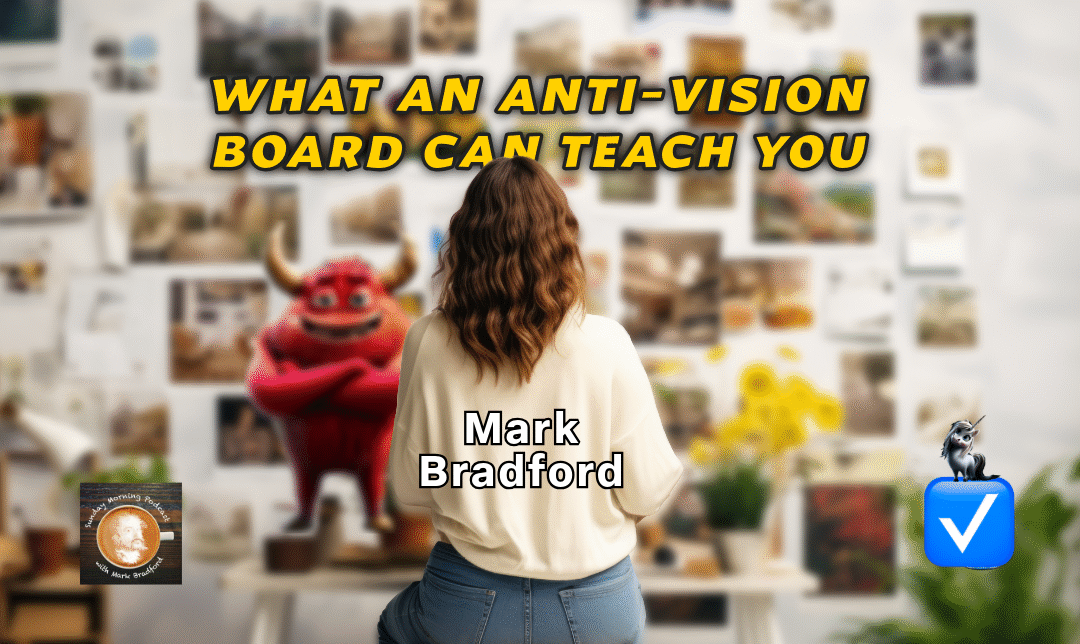
What is a vision board? What is an anti-vision board?
Transcript
Well, hey there. Welcome back. What’s your vision?
The Traditional Vision Board
So, here’s a question. Have you ever used a vision board? A vision board is typically a physical place, almost like a bulletin board. It’s usually something larger than a sheet of paper that people place pictures, words, and inspiration. It’s something that they create that they can look at and it inspires them. It’s their vision of the future. It’s the house they want to live in. It’s the relationship they want to have. It’s the success that they want to gain. And it evolves. In the olden olden days, people would essentially cut pictures out of magazines, nice glossy pictures that they would then place on this board with with a pin. And people still do that, but they tend to be more digital. For example, Pinterest can be a vision board and is probably used like that for most people who have one. Granted, there are people who use Pinterest specifically to sort of gather ideas when they’re doing renovations or their nails or what have you, but it’s a cool thing and I see absolutely nothing wrong with it and a lot right with it.
The only thing I would say would be wrong is if you just make a big giant square of pretty pictures, but you don’t let it really help you to go where you’re going. Now, how would a big box of pictures help you go where you’re going? Well, let’s talk about what the vision board represents in my book BeCAUSE! I talk about monsters and unicorns, which are the faces of us seeking pleasure and avoiding pain based on Freud’s pleasure principle. So, when you’re looking at a vision board, you’re essentially looking at a whole bunch of unicorns, saying, “Doesn’t it feel good to imagine yourself in this house? to imagine yourself in this relationship” I mean, they’re all good feelings.
That’s what the vision board is. It’s about you moving towards the pleasure of having, experiencing, knowing, embracing, and all that wonderful stuff.
Introducing the Anti-Vision Board
I started thinking about vision boards when I was looking at my CheckMark™ app. And if you haven’t checked it out, you should because I built a vision board into it. Uh, you can use your camera on your phone. You can upload photos to it and arrange it on your phone. It’s kind of cool. Mind you, it’s a small screen, but it’s kind of ever-present, which is cool. And you can look at it on your computer when you get back to your office. I broke the boards down into a number of boards like relationships and health and so forth. But that got me thinking. I felt like there was a board that was missing. What if you flipped everything around and you made a board of all the things you didn’t want? Now, if you literally made a board of the things you don’t want, that would you’d run out of board. Obviously, there’s a million things in life we don’t want, then there are probably just a few things that we really do want. But what if the things we don’t want are sometimes the things we have, right? Like if you’re in a job that you really don’t like, well, that’s something you’d put on that special board. And let’s call it an anti- vision board, right? It’s not my vision.
People tend to move away from things that cause them pain. So, if the vision boards are all populated by unicorns, then the anti- vision board is essentially driven by monsters, right? The monster of avoiding the pain of being in a house that’s cramped or in a neighborhood you don’t want to be in or in a dead-end job or a lack of relationship or a toxic relationship or something that just isn’t a good fit for you.
So, do you think an anti-vision board would be just as helpful as vision boards?
Perhaps in some ways it would be more helpful.
When Monsters and Unicorns Work Together
You see, a lot of the things that I’ve discovered when I think about monsters and unicorns is that a lot of them do have a flip side. If there’s a if there’s a unicorn pushing you towards pleasure, sometimes there’s also a monster pushing you away from the pain of that. Not in all cases, but in some cases there’s a distinct flip side and they kind of hold hands and work together, as I say. So, here’s an example. If you’re living in a house that’s okay, you probably don’t really have a monster saying, “Oh my god, this hurts.” But you could have on your vision board a really large house or a house with a really nice yard so that your kids can run around. That’s the unicorn saying, “Wow, that feels really good to have that.” But there’s no monster on the flip side saying, “Oh, I hate this house.”
But you could also be living in a house that you really don’t like. Uh it could have to do with the terms. It could have to do with the neighborhood has just gone down down the tubes, what have you. So you have both. You have the monster saying, “I don’t like this. We need to get out of here. And the unicorn of saying, “Oh, so beautiful. This one is really nice.” You see how there is actually a difference?
If you’ve heard the episode Waking Up to a Monster, you know that it’s not a great place to be in if you wake up every day and your entire day is motivated by avoiding pain. It’s not really how we should be living, right? Some of us have to. A lot of us have to. Sometimes a lot of us get into that area of life. It’s a funk or it’s just a it’s the chasm of life that we hope to to claw our way out of.
The Grounding Power of Anti-Vision
So if that’s the case, do we really want a vision board that’s telling us all the things that are bad in our life?
Well, yes, because it’s voluntary.
You may find an anti-vision board more motivating than a vision board. It also acts as a supplement to the vision board to sort of clarify what it is you’re actually looking for. Because you might say, “Well, look, I don’t want a giant house.” Okay, but I don’t like the one I’m living in. Okay, so you wouldn’t have a big giant house on your vision board, but you might have a picture of your existing house or the parts of your house that you really don’t like on your anti- vision board. You see, the anti- vision board is a bit more grounded because it’s something you’re already working with.
And sometimes you experience the pleasure of wanting a thing or moving towards a thing, but it feels like you’re just trying to reward yourself. And then you have some guilt and then you have some self-esteem issues that say, “Well, do I really deserve that?” What you’re really trying to say is, “I don’t deserve to have the thing that I have now.”
And creating an anti-vision board allows you to define the things in your life that you want to change.
Let me say that again. Having an anti-vision board allows you to define the things in your life you want to change.
Isn’t that the baseline? Because if you don’t know what you want to change and why, and the monsters will tell you why, then you’re not really going to do anything. It’s it’s sort of like the difference between someone really making themselves better and having a better life and somebody being shoved into a candy store and someone says, “Well, pick six things.” Well, I I I it’s all candy. I I don’t know. I don’t really see. Do you see the difference? It’s a huge difference especially for people who have a good work ethic, people who have humility. You shove those people into a candy store and nothing’s going to happen. But if you allow them to say, “Well, here are the things I would like to change.” Well, now we are going to make progress.
Build Your Boards
So, I would ask you a few things. Have you ever considered a vision board? Have you ever considered an anti-vision board?
What would be on your vision board? What would be on your anti- vision board? If you’re using the CheckMark™ app, you can actually activate the vision board, which includes an anti-vision board, which means you can literally flip to the anti-vision board, walk somewhere in your house or somewhere, and just snap a photo and go, “Yeah, that’s the thing I want to change.” and you carry that with you and it’s on your screen, too. Or you can be traditional and just put it up on your bulletin board or what have you. But I would suggest trying that at least to yourself answer the questions I just asked because it’s really kind of a a cool fascinating thing and I hope you enjoyed this and take care of you.
Thank you for listening.
BONUS:
- You can find the CheckMark™ app here. It’s completely free no credit card needed. Get it now!
- A walk through of this episode is available inside the CheckMark™ app
- The book BeCAUSE! is available on Amazon and wherever books are sold.
Podcast: Play in new window | Download
Subscribe: RSS

Schedule a 15 minute chat. See if I can help you.
Mark Bradford is the author of 10 books, both fiction and nonfiction, including the clinical psychologist-endorsed Three Voices, the new BeCAUSE! as well as the award-winning trilogy The Sword and the Sunflower.
Mark Bradford developed a system to achieve goals, manage your energy and understand and strengthen your path – it’s Alchemy for Life™.
He writes, coaches and speaks on the subject. For more information, tips and tricks subscribe to the podcast, join the mailing list, follow him on FB.
Articles are posted regularly on AlchemyFor.Life, and LinkedIn.