
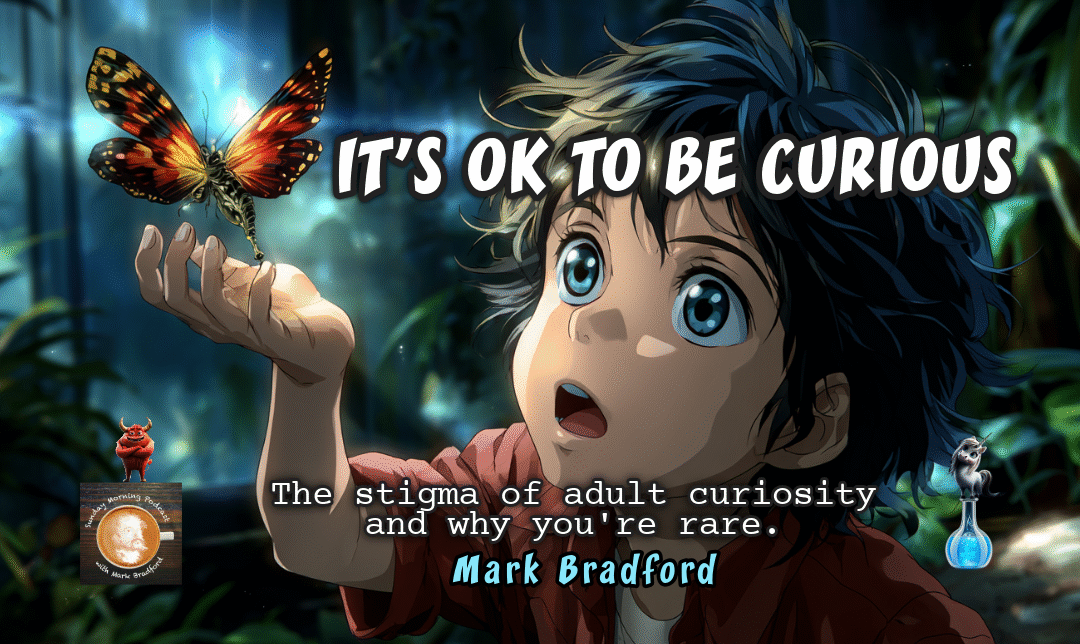
The Stigma of Adult Curiosity
You know it’s okay to be curious. You don’t need me to tell you that… or or or do you?
Let’s think about this and we’re jumping right in. Let’s talk about curiosity and what it means to you. There have probably been a number of times in your life in which you either demonstrated curiosity or saw someone else being curious. And probably more than half the time, the person being curious was made to feel a little self-conscious about said curiosity.
We sometimes equate curiosity with being nosy. Putting your interests in a place that it doesn’t belong. You know, well, leave that alone. Someone else knows about that. It’s not part of my job. I don’t know. Look, I don’t know the big picture, right? Maybe there’s a reason they do that. I don’t know. Or that information isn’t available or it’s a company secret or it’s classified.
Like many things, we celebrate curiosity in children, but at some point, we don’t. At some point in someone’s developmental progress, we say, “Okay, here’s some attributes that really only stick to children.” As an adult, we don’t we don’t do that. And I think sometimes curiosity is one of those.
Spotting the Spark of Genuine Interest
As someone who’s given a few talks and regularly speaks up at networking events and public events, I can see curiosity from a distance. I see the sparkle in someone’s eyes. I see their face light up. And it not necessarily that I’m such a great orator, but that they’re curious about what I’m laying out. They think, “Wait a second. Okay, that’s interesting. What else? I want to hear more. They stand out to me at a distance.
In fact, at a recent event, I was giving a talk and one person in the audience provided all the motivation for the talk for me. It’s because her face just lit up the entire time I was talking. You could tell that she wanted to know more and was just eating up the stuff that I was saying. and eating up is her being curious and saying, “Give me more data. I’m open to it.” That’s a cool frame of mind to be in.
The Mental Energy Required to Stay Curious
Well, why aren’t we all in that frame of mind 24/7? Well, it’s exhausting. Anyone who says they experience ADHD knows that for a lot of people there’s a period of hyperfocus and then there’s a period of confusion and that if you are open to a tremendous amount of data then you are processing a tremendous amount of data. I myself know I know what safeguards and restrictions I have to put on because my brain wants to process all data coming in all the time. It wants to process the two conversations going around around me in the restaurant while I’m having the conversation I’m actually involved in. I have to turn that off.
And curiosity can do that to your brain. If you’re curious, you can say, “Well, why did you put that there? Why? Why is that this color? Why do you go that way? Why do you walk around the car that way? Why does this work this way? There’s a million questions. And again, as I said before, we praise children for these questions. And we chastise adults for the same.
It’s very easy to put your head down and say, “Okay, that’s not my business, not my problem. I have more than enough to deal with dealing with my stuff. I don’t have the mental energy to focus on something that’s not a concern, something I don’t get paid for, something I have no control over, and frankly, I don’t have an interest in. And that’s fine. That’s perfectly fine. But but don’t let your curiosity be diminished because of a stigma or because you think you’re not allowed to or it’s a waste of energy.
How Internal Questions Lead to Personal Breakthroughs
Having curiosity can lead you to entirely new hobbies and even a new career. And as I said in job, career or calling, you can be focused on your job but have an entirely different calling. Your internal curiosity, in other words, your curiosity about yourself, the way you react, the way your life is, can lead you to discover things that help other people. That is a lot of the drive of how I started writing experimental psychology books. I had and have questions about my own psychology which causes me to ask questions, research, distill, and disseminate. And hopefully it helps other people who have had the same questions.
Answering your own questions, not surprisingly, can help you answer other people’s questions and make you a better teacher. There are numerous examples of inventions and discoveries that were made by quote unquote normal people, quote unquote lay people, amateur astronomers, etc. that led to massive discoveries and and massive benefits for humanity because they were curious. They didn’t run into the stigma wall. They didn’t allow themselves to tell themselves that they were where they didn’t belong.
Setting Healthy Boundaries for Your Inquiries
Now, on the flip side of that, obviously wandering into traffic and saying, “Hey, why are you guys going this way?” Or when there’s a an active arrest going on and walking right up to the officers and saying, “Hey, what’s going on over here? What what did this guy do?” Knocking on the doors that lead to the pilots while you are mid-flight or literally grabbing the steering wheel while you’re in an Uber might all be bad ideas. They are examples of perhaps when you should curtail your curiosity.
Now, there are versions of everything I just said that can be handled non-physically. You can still get answers via research, asking questions, and so forth. So, obviously, there are nuances to how you handle curiosity, but the takeaway from this is I encourage you to be curious. I encourage you to enjoy the youthful energy of curiosity and just give it a big hug when it opens its eyes every so often. That kind of thing can clarify your path, invigorate you, and kind of make you feel more alive. And I think if you’re listening to this podcast, you’re already someone that at least to a point understands that curiosity is important and you at least embrace some of it.
So, keep embracing, keep looking, have fun, and I’ll see you next time.
Podcast: Play in new window | Download
Subscribe: RSS

Schedule a 15 minute chat. See if I can help you.
Mark Bradford is the author of 10 books, both fiction and nonfiction, including the clinical psychologist-endorsed Three Voices, the new BeCAUSE! as well as the award-winning trilogy The Sword and the Sunflower.
Mark Bradford developed a system to achieve goals, manage your energy and understand and strengthen your path – it’s Alchemy for Life™.
He writes, coaches and speaks on the subject. For more information, tips and tricks subscribe to the podcast, join the mailing list, follow him on FB.
Articles are posted regularly on AlchemyFor.Life, and LinkedIn.