
What It Really Means to Be on the Fence
Well, hey there. Welcome back.
You know, at one point, you might have been on the fence about whether you’re going to listen to this episode or stick with the podcast or subscribe to it.
There may be hundreds of things you’ve been on the fence about in your life.
And when was the last time you actually used that phrase with another human?
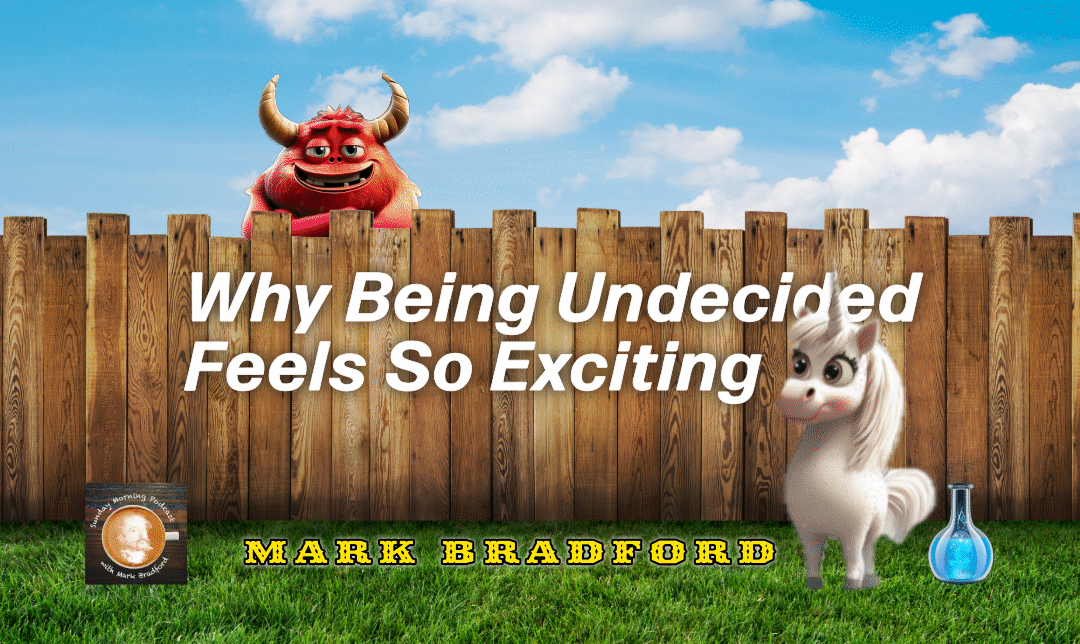
Because depending on your definition, it may or may not mean undecided. So let’s talk about it. And let’s talk about those monsters and unicorns that are involved in it.
So, but first, let’s talk about what it isn’t. To me, it’s not a lack of decisiveness. It’s not a lack of being in one direction or another. Because if you say, “Well, I like this, but do I want it? Hm, I don’t know.”
Well, then you don’t really have a lot of energy pushing you to make that decision or to purchase something or what have you.
You may think, “Okay, well, I’d like to agree to this, but I just… I don’t have the resources for it, the energy for it, the time for it, the… the desire.”
Or you may think, “I don’t want this at all. I don’t want this at all, but I… I don’t want to tell this person. So, I’ll just string them along,” which is another fun phrase.
None of those are really being on the fence. On the fence makes you literally feel like you’re sort of teetering on a very precarious position. You’re going to fall one way or the other way. You’re going to say yes, or you’re going to say no. You’re going to take the plunge, or you’re not.
Making a decision requires time and energy and, in some cases, resources. Or, in some cases, it may cost you a considerable amount of resources if you make the wrong decision.
It can feel funny, it can feel out of character, or it can kind of feel exciting, because you may feel both the danger or the risk, at the same time, you feel the pleasure of going, “Wow, if I do this, this good thing will happen and make me feel good.”
Lots of monsters and unicorns…
I suppose that sounds like gambling a little bit, doesn’t it? But it also sounds like a couple of monsters and unicorns pulling at you. One of them is trying to pull you to one side of the fence, one of them is trying to pull you to the other.
You have the monster saying, “If you do this, it’s going to hurt. You’re going to waste money, you’re going to waste time, you’re going to get tricked, it’s a scam, it’s not something you need, you’re going to regret it.”
That could be one monster, that could be a number of monsters.
You can have a monster working on the other side saying, “If you don’t do this, it’s going to hurt. If you don’t make this decision, you’re going to continue to suffer, you’re going to continue to be in pain. You have to do this.”
You can have a unicorn saying, “You know what? Stay here. Don’t… don’t do this. Don’t make this decision, because not making this decision makes us feel really good. It feels good not to do this. So, just leave it as a default, as a no.”
You could also have one on the other side saying, “You know, man, this’ll feel good if you do this. Man, this is what you have wanted. Look at how your friends are going to revere you. You’re going to be the coolest guy. You are going to have the neatest stuff. They’re going to come over and go, ‘Wow.’ Or they’re going to say, ‘Wow, I can’t believe that you did this. You’re impressing me, and the best person ever.'”
And now imagine all those monsters and unicorns are are joining hands, they’re working together to yank you from one side to the other. They’re pulling you. And you’re, again, teeter-tottering on there. That is exciting.
So, there’s a certain excitement to being on the fence, and it can be kind of rare.
People who are decisive typically do a couple of things:
They move quickly, and they try to remove emotion from it.
But in both cases, sometimes that doesn’t work. Sometimes you can’t move quickly because you might have to do some research, and the research might tell you you were really wrong.
Taking the emotion out sounds great on paper, but what it really sounds like you’re doing is you’re taking a monster or unicorn out that’s disconnected. Again, the decision as to whether to purchase a large TV because you decide you want one or you need one for movies or so forth, if that’s affected by the emotion of “my friends will think I’m cool,” well, then that’s disconnected. So by taking the emotion out, you’re really just taking out the control of that monster or unicorn in this particular equation.
Impulse Purchases vs. Strategic Waiting
I use TV because it… it… it’s something that a lot of people buy. The size of it tends to rely sometimes on what you think your friends will think of it or your family, and so forth. It’s sometimes it’s a one-upmanship kind of thing. It… it’s a good thing to pick on. I mean, people buy TVs, people like large TVs.
This is my way, or the way that I purchased my TV, which is like 100 years old now. 😆
I stalked it for months and months. Wait, I was like, “I’m probably going to get this thing.” But there was nothing really pushing me to get it. I wasn’t on the fence about getting it, I knew the time wasn’t right. And then one day the price dropped dramatically, and I made an impulse purchase—which was not an impulse purchase. It was a purchase that I had been waiting and building for for many, many months, actually.
So I wasn’t on the fence, but I was collecting data, and based on what I was seeing and thinking, I thought, “Well, when the price drops, I’m going to get it.” So I just had a variable that I had to match, and when I matched that, everything was peachy.
Handling Indecisive Clients and the CEO Mindset
When you are in a transaction with someone, and you want them to make one of the decisions, and they are on the fence, it can be, at minimum, a little bit frustrating, and at maximum, it can be maddening.
You will then push back and say, “Look, I just need you to make this decision. Just make a decision. Come on, just pick one. Look, at this point in the game, I’d rather you set no, because I just need to know.”
If you are wise in the ways of the thing that you do, you may already know what to do and say, “Okay, when someone is in this frame of mind, that’s when I back off, and I say I’ll revisit this. I put them in my customer management software and and we come back to it. Big deal.”
I can relate once again for when I am asking someone to be on the podcast. And I have mentioned this before, that in some cases I have to pursue someone for months. And in some cases they say yes right away. And in fact, the podcast episode called “A Fast No Beats a Slow Yes,” I talked about my version of the CEO mindset.
Some people talk about the CEO mindset, they have books written, but in my case, I think the CEO mindset is just somebody who can just say yes or no quickly.
Why a Fast No Beats a Slow Yes!
And it’s not the yes or no quickly because they instantly can assess a situation, although that certainly helps. They are more likely people who will just say no if they know it’s a no.
And that’s why the fast no beats a slow yes, because if I approach someone and they give me a nice, solid no, and I know it’s not going to change and there’s nothing I can say to sell them on this, well, then we’re done. All done. No more energy needed, move on to the next.
It’s not surprising, this same concept applies to dating.
But if someone is a yes or an almost yes, well, then you keep going. And I’ve done that with a few guests in which I had to pursue them for a while, you know, and sometimes they’ll say, “Hey, can you reach out to me again in such and such?” And more often than not, that’s just a no that wastes my time.
But let’s get back to this quintessential being on the fence. So you already can visualize the monsters and unicorns. And if you can actually see them, if you can actually decide and feel out what they’re telling you, well, I’ll bet that you’re not going to be on the fence much longer.
As always, if you want to learn more about monsters and unicorns, pick up a copy of BeCAUSE!.
And as always, thank you for listening. Take care of yourself.
Podcast: Play in new window | Download
Subscribe: RSS

Schedule a 15 minute chat. See if I can help you.
Mark Bradford is the author of 10 books, both fiction and nonfiction, including the clinical psychologist-endorsed Three Voices, the new BeCAUSE! as well as the award-winning trilogy The Sword and the Sunflower.
Mark Bradford developed a system to achieve goals, manage your energy and understand and strengthen your path – it’s Alchemy for Life™.
He writes, coaches and speaks on the subject. For more information, tips and tricks subscribe to the podcast, join the mailing list, follow him on FB.
Articles are posted regularly on AlchemyFor.Life, and LinkedIn.