
Understanding Predatory Bias, Evolutionary Survival Instincts and Cones & Rods (also pareidolia and apophenia)
Well, hey there. Welcome back.
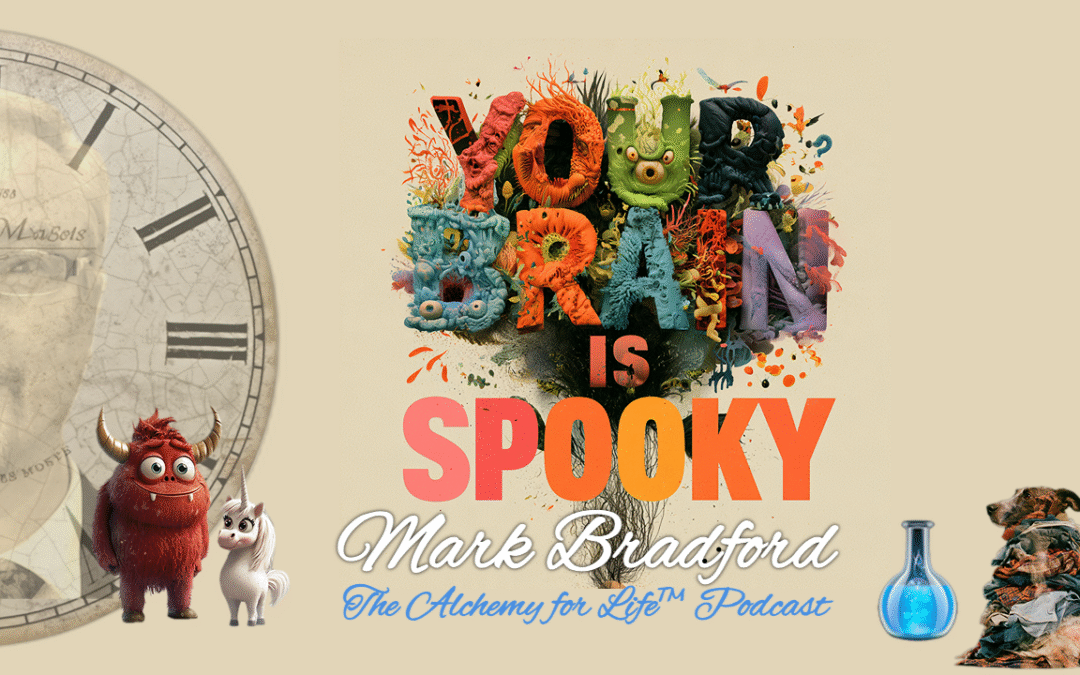
Have you ever—oh, wait, what is… Oh, sorry. I was confused there. I thought the pile of clothing on the floor was a dog.
Has that ever happened to you?
What about when you’re taking a walk, or you’re outside, or driving, and it’s dusk or dawn?
Then does it happen?
Have you ever thought a tree or a pole was a person waiting for a bus? The coat hanging up in an open closet is a man standing waiting to attack?
We’ve all experienced this.
Sometimes it’s kind of unnerving, sometimes it’s interesting, and sometimes it can make you laugh.
In the episode called “The Holy Grail of Positivity Bias,” I talked about how we have a built-in system for negativity, and that’s why we are still alive after all these generations. Fire bad, bear attacking is bad, stay away from cliffs, don’t eat that. Stuff like that.
Well, our vision has something similar to that built in. In fact, it has a lot of things built into it, which is what creates the whole “pile of clothing is actually a dog” kind of concept.
So, our vision has predatory bias, meaning if it doesn’t recognize a thing, maybe it’s a thing trying to hurt us.
It’s why our first instinct is to scream or jump or reel away from something that is in our field of view suddenly. Like, someone who’s your best friend or someone you’re madly in love with is standing next to you, you turn around, and you don’t go, “Oh, I’m so happy to see you,” you go, “Oh my God!” and you jump away.
Because if you didn’t, your ancestors or you could be eaten by something. Shoot first, ask questions later.
Eye Hardware, Rods, Cones, and Pareidolia
So let’s talk about our eye hardware.
So, we have cones and rods, as you may know.
The cones are high-resolution optic devices that recognize color. The rods are for lower light and essentially non-color input.
So, when lighting drops to a certain level, your cones can’t really provide much information, they don’t fire off, and then we see everything as kind of a gray, which is kind of really cool. If you’ve ever taken a walk or been outside early morning or late night, dusk and dawn, you notice the color just drains out of things, and it’s kind of poetic.
That’s your eyes switching from your cones to your rods. Things are of a lesser resolution, you could say. They’re they’re they’re grainy black-and-white kind of stuff.
So when your brain is fed this lesser information, not only is it still dealing with that whole predatory reflex, it’s now dealing with something it does all the time, but you notice it more, which is this top-down programming, which is this predictive programming. “Hey, what is… Oh, that’s probably a dog. Hey, that’s a stranger. Hey, that’s a…” It’s doing that before you even get to really see what it is you’re seeing.
I thought about this so hard, I actually saw the change. Most people don’t. They just have like a a thought of, “Oh my god. Oh, that’s that’s fine. That’s a tree.”
And I saw a tree near my house change from a person to a tree as I was driving up one day. And no, this isn’t an admission that I’m going crazy. That’s actually episode 1,000. 👀
We also have another element, which is pareidolia, and you may or may not know what it is. You know what it is, but you may not have heard the word for it. Pareidolia is basically when we see faces and objects and things that are very familiar to us in things that they’re just they’re not there. You look at an outlet, and you go, “Oh look, it’s kind of like a happy face.”
You look in the sky at some clouds, and you say, “Oh, I see a puppy.”
So your brain is doing all this processing at the same time you’re simply just getting visual information.
And the processing is biased towards something bad, except for the pareidolia for the most part, which can be something good.
Why Low-Light Environments Create Spooky Experiences
And this is, in my opinion, what sort of constitutes what spooky is.
Think about it. If you go outside and and it’s pitch black, it’s pitch black, that’s that’s it. But if you shine a flashlight, you’re going to be using a lot of light, and you’ll be able to see colors and everything else. You get some pretty crisp visual information. There’s nothing really spooky about necessarily shining a light on something scary, you go, “Oh my God, I saw something scary.”
But if you go outside, and most of the light and color has drained away, all of a sudden it’s spooky! What could that be in the shadows? I saw something move! Oh my God, I’m leaving.
How Apophenia and Cognitive Biases Impact Business and Life Decisions
So let that sink in for a little bit, because I’m I’m going to switch gears in a way.
We’re going to take everything we just learned and apply that to something else.
So, if you have all this processing and bias and so forth in place when it comes to visual information that’s input into your system, what happens when you get a new idea? Or someone presents something to you?
Well, those same systems, or systems similar to them structurally, kick into effect as well. You still have negativity bias. You still have predatory bias. And you have a form of pareidolia.
And that’s called apophenia.
It’s essentially our tendency to perceive meaningful connections, patterns, and connections between things that are completely unrelated or random.
Am I saying this necessarily kicks in when when you’re looking at the menu and you say, “Well, I’ll have the chicken”?
Well, in in in a way… well, let’s not get into that. But…
it’s definitely something you have to be aware of when it comes to larger concepts and systems. If someone presents to you an entire system and says, “Hey, what do you think about this? This is the direction we’re going to to move. We’re going to merge with an entire company. We’re going to switch from this company to this company as far as who produces or supplies this thing for us.”
And you might say, “Well, I we don’t do that.” Well, yeah, but you’re on the receiving end of it. If you are supplying something, if you are providing goods and services, and someone decides to go with you, more likely than not, they’ve already gone with someone else previous. They’re not suddenly in need of a product they’ve never needed. Now, that does happen, but most of the time it’s someone going with someone else.
And so when they do that, conceptually, intellectually, from a problem-solving standpoint, they are going to be using all of these systems in place we just talked about. And so are you.
If you have ever made a decision or, more likely, been part of a company that made a decision and you thought, “Why did they do that?”
If you think about these terms, it can explain that a little better. It might not be very satisfactory, because you think, “That was a bad decision,” but at least it helps you to understand the why of it.
Think about it. Let’s go back to our original discussion on vision. If you’re walking through a a scary, spooky area, and your cones are doing nothing, and your rods are doing the best they can, and you go, “Oh, what is… Oh, okay, phew. I thought that was an animal attacking me.”
“I would like to prevent that in the future. I will make this decision.” Think about that. That’s how that works.
If you’re selling kitchen alligator insurance to people in the Midwest, you’re not going to have a lot of success. However, if someone wakes up one morning at 2:00 in the morning because they want a glass of water, and they don’t want to turn the lights on, and they walk in there, and they see something on the floor, and they go, “Oh my God!”
Suddenly, it doesn’t sound like a terrible idea to get that insurance.
People sometimes have close calls with their imagination!
If you’re really being skeptical of me right now, I would say, safely, go take a walk at dusk or dawn. Go take a walk in your neighborhood, go take a walk in an area you’re unfamiliar with. Now this sounds like terrible advice, so don’t do it, so we’re only going to do it in our minds, but if you were to do that, I would bet you that a lot of the things I’m talking about would kick in—a lot of it.
It doesn’t matter how brave or strong you are. We’re talking about systems in place, evolutionarily, that have been there for a very long time for a very good reason.
Overcoming Your Caveman Brain Maybe?
So what now? Do we just laugh at our caveman brains? No! Just like I told you in “The Holy Grail of Positivity Bias,” what if we flip that around?
If you become aware of the fact that you have this system in place, you can have more control over it. You can be the driver. You can sit in your chair and say, “No, I’m in control.”
“I understand that might look like that, but logically, it’s this.” And that can apply to both your vision and your decisions. So think about that.
And I’d love to hear your feedback.
And thank you, and… Wait, what is that behind you?
Take care.
Thank you for listening as always. Go to markbradford.org to see all my author-related things. Go to Alchemy for Life to see coaching, speaking, writing, and this podcast.
Alchemy for Life™ theme by Mark Bradford and Alchemy for Life. All background music is by Audionautix and Jason Shaw.
Podcast: Play in new window | Download
Subscribe: RSS

Schedule a 15 minute chat. See if I can help you.
Mark Bradford is the author of 10 books, both fiction and nonfiction, including the clinical psychologist-endorsed Three Voices, the new BeCAUSE! as well as the award-winning trilogy The Sword and the Sunflower.
Mark Bradford developed a system to achieve goals, manage your energy and understand and strengthen your path – it’s Alchemy for Life™.
He writes, coaches and speaks on the subject. For more information, tips and tricks subscribe to the podcast, join the mailing list, follow him on FB.
Articles are posted regularly on AlchemyFor.Life, and LinkedIn.