
The Blind Spot to Blind Spots: Why your Mind Seeks Comfort Over Truth
Well, hey there. Welcome back.
You know, every article I’ve written, and I have over 3 million views on my articles on Quora, every non-fiction book I’ve written, and every one of these 350-plus podcast episodes, they were all written with a simple premise. And that premise is that I and everyone else are operating from the standpoint of accepting and trading empirical data with no intent to deceive, obfuscate, or otherwise mislead.
So imagine my surprise when I realized I had a blind spot. And that blind spot is to a blind spot.
Let me explain.
If you’ve been an outsider in anything ranging from a workplace, a group, even a religion, you’ll understand what I’m about to tell you.
Typically the human mind does not operate on a fact-seeking mission, but instead, it’s comfort-seeking. I’m not talking about a couch or a comfy bed, even though that sounds delightful right now, and maybe some hot chocolate and little tiny marshmallows, but not too many. Okay, well maybe like twice as much as you should have. Anyway, the human mind wants to protect itself, and I’ve mentioned before and how our psyche has a number of protective layers which you run head into if you try to coach, guide, or mentor someone.
It’s not like they say 2 + 2 = 7 and you say, “Oh, no, no, no, 2 + 2 = 4,” and they go, “Oh, I get it. Thanks, coach!”
Challenging someone’s worldview can be trying, at the least.
If you’re part of an organization or a group that has a certain view of things, and you try to challenge that view, more likely than not, there will be a problem. If the view they have is something they’ve built to protect themselves from something being hurtful, it will be more dangerous for you to do so, and you’ll end up on the outside of the group.
Murray Bowen’s Family Systems Theory: The Group as a Protective Organism
There are a couple of stories of people who were very solid, card-carrying member of a group or organization, and it was their devout openness to logic that opened their eyes to the fact that something was amiss, and they were forcibly ejected. This typically caused them to be even stronger about their desire to find the truth.
A behavioral psychologist named Murray, and I’ll link that in the article, developed a position on this. And it’s widely regarded as the de facto work on family unit dynamics. He states that a family unit acts like an organism, a protective organism, and it will forcibly eject anything challenging that belief system of this organism.
The organism exists not to pursue the truth, but to simply protect itself, to maintain status quo and to repel anything that differs from the system.
If you’re listening carefully, you’ll notice that there’s nothing in that language that has anything to do with right or wrong, or true or false. So imagine a protective organism that’s dysfunctional. Whether it’s a family or organization, belief system, religion, spirituality, etc., being a dysfunctional organism that exerts that kind of protective control not only keeps all the entities involved in a false and probably destructive reality, but forcibly objects to anything or anyone that challenges that reality.
Challenge it, and it will result in corrective action and ultimately, ejection from the group.
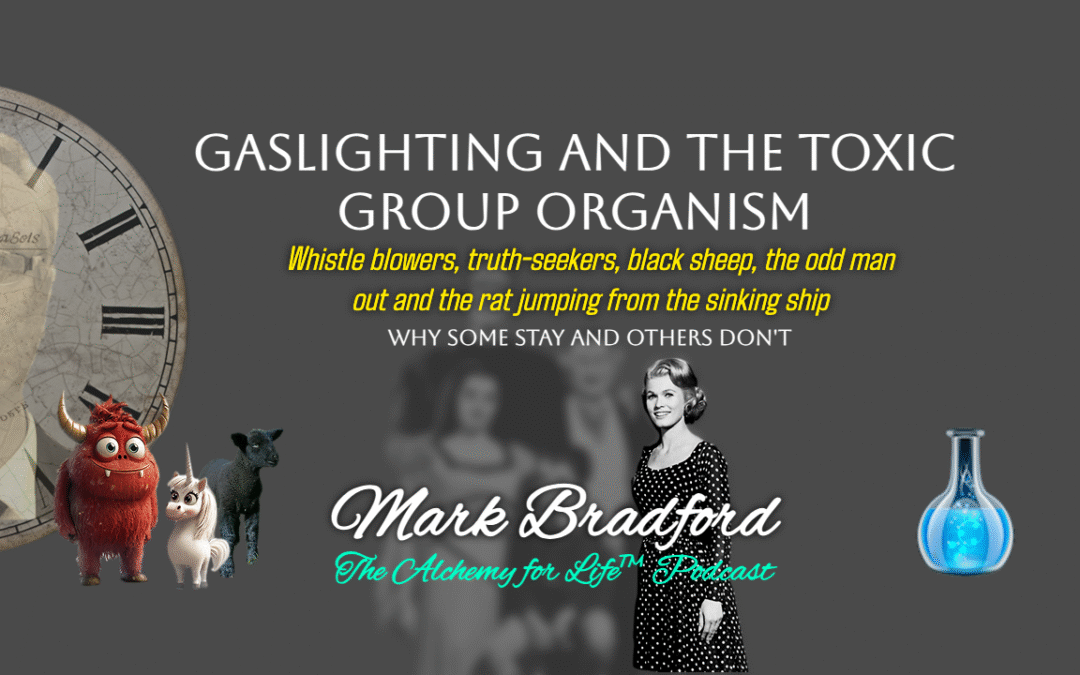
Thus the whistleblower, the people who lose contact with their work buddies upon pursuing higher, less dysfunctional aspirations, the rats that jump the sinking ship, and the quintessential black sheeps of families. I stand before you as more than one of those, and it shows, and it hurts. But it’s the right thing to do.
Organizational Gaslighting and Avoidance in Dating Culture – It’s not you, it’s me…
What we are essentially talking about is a form of gaslighting: explaining and stating reality in such a way that is simply not true, but to guide the narrative. You actually expect this in the realm of politics, not so much in families. However, the more you talk to others to learn about their families or organizational units, the more you find that this is almost the norm, rather than the exception. Gaslighting and deception abounds.
Let’s talk about dating. In the world of dating, it has become almost a requirement to exhibit some sort of gaslighting. If you’re not feeling a connection for one reason or another, it’s more likely you’re just going to try to gloss over it as simply as possible, or stop communicating and hope they feel the same way, or become a ghost. You have been on the giving and receiving of this, whether you wanted to be or not, because a part of gaslighting is the avoidance of conflict and pain. It’s even easier to be thought of that you’re a jerk than you don’t approve of someone, or, gasp, you would point out an obvious fault. I’ve been in that position many times and naively stated the truth, only to be burned by that. I learned my lesson of being able to play the gaslighting card the hard way. Do I do that? I try not to, but it does happen.
So to come full circle, this is really the very first time I talked about this. Yes, we did have one episode on ghosting and why it happens, but we didn’t talk about gaslighting and being gaslit by an entire organization or family unit. My own experience in speaking up about occurrences, negative happenings, is exactly what I described in the beginning: the shunning and the eventual ejection. You know, bringing up the subject again at a later date results in a sort of blank stare, and even less access to the unit and the members of the unit.
The Power of Validation: Monsters, Unicorns, and Speaking to Groups
If you’ve ever been an outsider in any way, shape, or form, you know exactly what I’m talking about. But you may not have known the mechanism by which it operates. It’s much easier to point the finger at an individual person. After all, we’re not used to dealing with a group as an organism, per se. As an aside, that’s actually how I regard speaking. It’s probably my biggest tip I could give to someone who is nervous about speaking or entering the world of speaking. It’s that you look at an entire audience as one person.
The problem with the trap of gaslighting is that even if you do find yourself to be a truth-seeking being, there’s more to us than meets the eye. And although we don’t change into a car, which would be really, like, super cool, we are governed by more than just seeking the truth. This is what can make a relationship so complex. You detect the action of gaslighting, you find the person may not be that into you, you may find the person who is dishonest, but you may also be driven by desire, and the positivity of desire can outweigh, in your mind, the negativity of the gaslighting. You see the forest for the trees, you see the writing on the wall, but you ignore it in pursuit of that thing, whether that’s love or wink-wink nudge-nudge, or the most powerful thing in the universe, as I’ve said in The Status Game, too: validation.
In the framework of my Monsters and Unicorns behavioral mapping, your unicorn for validation, or for the pleasure of what the affection or connection provides, is stronger than the monster trying to push you away from the pain of being lied to, or even being part of a dysfunctional relationship, whether that relationship is with one person or a group.
The Cost of Belonging: Deciding When to Walk Away
So what I can tell you are really two things. I can’t tell you to go back in time and say, “Hey, you should have woken up when you were being gaslit at that point.” In a relationship or organization you are in right now, if your gut feeling, your first voice, is telling you that something’s wrong, you have to weigh just how much you can accept. So many people work for businesses in which they know something is not right, something is off, you’re not thrilled with the way that it does business, but you sure like paying your bills and buying groceries for your kids. In the family unit, it’s pretty difficult to give that up. It’s pretty difficult to keep speaking up and look upon blank stares. Being ostracized and turned into a black sheep can be very painful. A lot of people weigh that. A lot of people know that they would just prefer to be part of something dysfunctional than be ejected by it.
So moving forward, you have to weigh that. You have to weigh that in your relationships, you have to weigh that in your family, your business, anything you’re a part of. How much of the negativity is an open, dirty secret in what you’re a part of? Is it worth being ejected? Is it worth being a whistleblower, or the black sheep, or the shunned upon, or the rat jumping from the sinking ship? That’s something you have to determine, not something I can decree from you from my soapbox. Ultimately, though, I want you to take care of you, because my relationship is with you. So at the risk of being redundant, take care of you. Thanks.
Thank you for listening as always. Go to markbradford.org to see all my author-related things. Go to Alchemy for Life to see coaching, speaking, writing, and this podcast.
Alchemy for Life theme by Mark Bradford and Alchemy for Life. All background music is by Audionautix and Jason Shaw.
Podcast: Play in new window | Download
Subscribe: RSS

Schedule a 15 minute chat. See if I can help you.
Mark Bradford is the author of 10 books, both fiction and nonfiction, including the clinical psychologist-endorsed Three Voices, the new BeCAUSE! as well as the award-winning trilogy The Sword and the Sunflower.
Mark Bradford developed a system to achieve goals, manage your energy and understand and strengthen your path – it’s Alchemy for Life™.
He writes, coaches and speaks on the subject. For more information, tips and tricks subscribe to the podcast, join the mailing list, follow him on FB.
Articles are posted regularly on AlchemyFor.Life, and LinkedIn.