
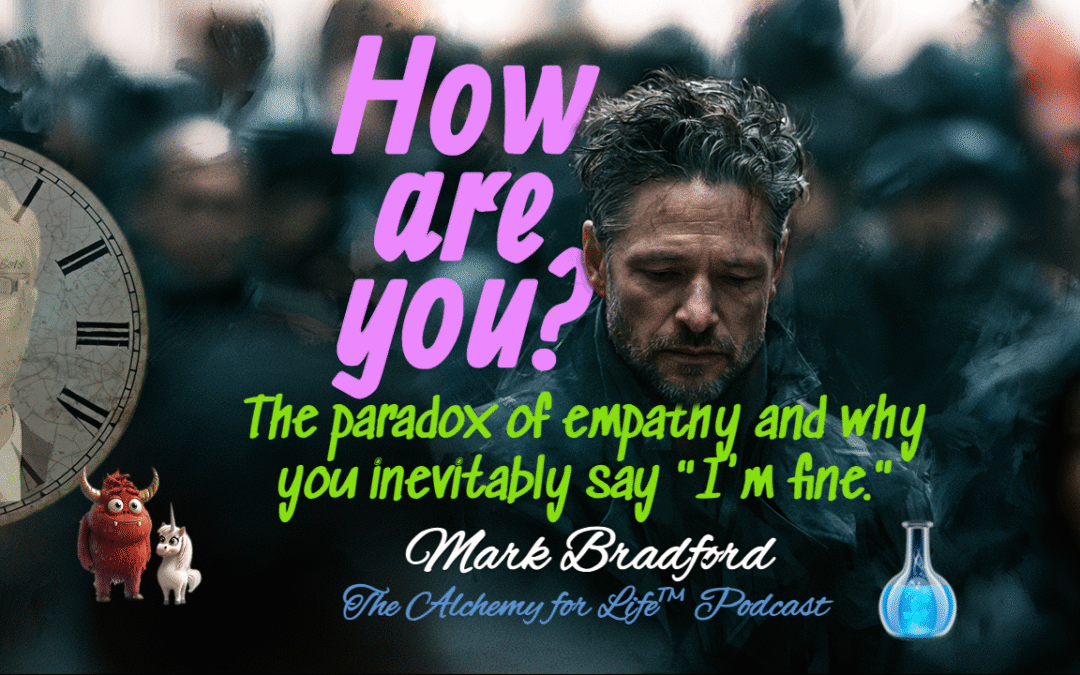
Why We Hide Our Real Feelings When Asked “How Are You?”
Well, hey there. Welcome back.
How are you?
No, I mean it.
How are you doing?
Are you okay? Are you good? Are you fine? Are you going through something?
Odds are that right now you’re not really registering that someone is genuinely curious as to how you’re doing. So you’re not really thinking about how you’re doing, you’re just thinking, “Okay, yeah, I’m I’m okay. Let’s get to the other point in the in the conversation. Let’s get to the good part of this podcast, right?”
If a person asks you that in person, your response and your ability to sort of dig down deep is going to vary based on a number of things. It’s going to vary based on your relationship with the person, the social setting—so is it somebody in passing, is it someone getting coffee at the same time you are, and they’re giving you that same, “Hey, hi, how you doing?” and you say, “I’m fine,” regardless of how wonderful or terrible you are.
It’s also going to vary based on certain things you have set up as protective shells, and we all have that. Our psyche is protected on a number of layers. In the same way that if somebody just walks up to you and says, “You’re doing it wrong, you’re wrong,” you’ll immediately have a protective layer that’ll say, “Wait, wait, I’m I’m not wrong, especially to a stranger. Hold on. Hold on, don’t accept what they’re about to say.”
The Paradox of Empathy
It’s the same thing as if someone says, “Tell me deeply how you’re doing. Reveal to me your most innermost pain.”
That’s not going to happen.
That may not even happen with someone you’re very close to. The odd thing is, it’s more likely to happen with someone that you’re not very close to. But it’s probably not going to happen at the water cooler, and it’s certainly not going to happen with some disembodied voice that already’s recorded this, that can’t reply back to you. I can’t reply back to you, right?
So if you truly were to say to me, or you just pause this and you go, “Okay,” and you’d vent in your car about how you’re really effing doing, you wouldn’t get the advantage of being validated, right? I wouldn’t be able to look at you and go, “Man, that sucks,” or “Oh wow, that’s quite the triumph,” or “Huh, tell me more about this thing that’s happening in your life.”
And I can tell you that I’d like nothing more than to do that. I’d like nothing more than to be able to somehow teleport into your car or next to you or what have you, and actually look into your eyes and listen and and say, “Okay, you know, tell me more, I’m listening.”
Our capacity for accepting someone’s empathy is, like I said, greatly variable, and it depends on a lot of things. People say trust must be earned, and it must, but that doesn’t explain why a stranger in pain will suddenly trauma dump on someone. They don’t trust that person, they just need that person. They need that person to listen to them. They need that person to understand how they’re feeling inside.
It boggles my mind to know just how many people are out there that really need this.
Japanese “Snack” Bars, Trauma Dumping, and Anonymity
There’s a service in Japan where you essentially pay 20 times the value of the snack that you’re going to get from someone, and it’s literally called The Snack, because what comes with it is someone who listens. And you get to open your heart up and just dump things out to them.
Obviously, there’s a layer of anonymity that comes with it. I mean, you’re there in person and they see what you look like and what your name is and so forth, but there’s a layer of anonymity, which is why it’s easier sometimes to tell a a stranger or a semi-stranger about something going on in your life than it is someone that you’re going to see every day.
I’m not saying you should rush out and and trauma dump for 20 minutes, only to have them say, “Sir, this is a Wendy’s,” versus you telling your wife or husband how you feel. I think communication between you and your spouse and significant other and pals is vitally important, and in a lot of times, in a lot of circumstances, it simply doesn’t happen.
Cultural Barriers and Vulnerability in Relationships
There are cultural and sex-based barriers, and when I say sex, I mean male or female. Men are taught at an early age to suck it up and be stoic, and a lot of men, unfortunately, find that in their relationships, once they become truly vulnerable, the relationship changes, and sometimes it ends.
So there’s obviously a need for this layer of semi-autonomy with a stranger in which you can truly vocalize what’s on your mind. The space where you can just say, “Look, this has always bothered me and I’ve had to deal with this, and this is something that’s been going on forever, and no, I’m not okay. I say I’m okay, but I’m not okay.” There’s a space for that.
I’ve thought about this for a while. I have a forte for creating interactive things, interactive software and websites and and so forth. What I don’t have a forte for is reaching people so that they feel comfortable doing that in a in a in a manner that makes sense to them.
So I can’t teleport next to you into your car or wherever you are listening to this. I can’t look in your eyes and feel your pain and help and hold your hand or put my hand on your shoulder or whatever is appropriate or give you a hug. I want to, I wish I could, but I can’t, because this is a one-way communication.
I can make you feel seen and validated by talking about something that’s near and dear to your heart, in which you didn’t think anyone else felt the same way. I can make you feel better by giving you a solution, or at least an understanding, to something that you are going through. But it still bothers me that I can’t do more.
Creating a Safe, Interactive Space to Be (Truly) Heard
Now the asterisk is that, yes, I can do more, actually, if if you’re in a seminar or in a group coaching or in a direct coaching with me, I absolutely can do more with you, but I’m not really talking about that, and if you’re interested in pursuing that, please, by all means, talk to me. But I’m talking about the vast majority of people who wouldn’t be doing that, people who are casually listening to my podcast episodes and may get a kick out of one or may find one to be really useful, or read one or more of my books and go, “Oh, I’m getting a lot out of that.”
So I’m being honest and vulnerable with you to tell you that I’ve had this desire to do more, but there are a lot of barriers between me and you. One of them is the fact that I’m only one person, the the fact that I cannot teleport to a million places at once and listen to someone, the fact that it would be very undoable and very unsafe to say, “Here’s a phone number, just call me,” and the fact that 99% of the people wouldn’t do that even if it was available.
But what would cause you to do that?
What would make you feel so safe and so anonymous and so validated and so heard that you would do it?
What exactly does that look like to you? Is it a form on a website? Is it an email? Is it something else? Is it a seminar or meeting? Is it a group setting, or is it a personal one-on-one setting? And what is it called? What would a what would a what would a seminar or what would a group setting be called that would make you say, “I’m going to do this. This is what I’ve been waiting for. I need to feel heard”?
And how is it constructed in such a way that it’s just not a lot of people standing up and talking about a problem for 30 minutes? I mean, you run out of time with one person, and if you have 30, 50, 100 people there, or even if it’s a small group of 10, how do they all feel heard and validated?
I will tell you that the closest I’ve come to this is that I did group coaching. I did group coaching actually for dads who were divorced or going through a divorce. Because a lot of their problems were similar and their experiences were similar, I was able to address them as a group. But I’m talking about everyone, including you who’s listening to this.
So if you’re interested in this and would participate and have some ideas on it, you can write me at heymark@markbradford.org. That’s heymark all one word at markbradford.org. Thanks.
Thank you for listening as always. Go to markbradford.org to see all my author-related things. Go to Alchemy for Life to see coaching, speaking, writing, and this podcast.
Alchemy for Life theme by Mark Bradford and Alchemy for Life. All background music is by Audionautix and Jason Shaw.
Podcast: Play in new window | Download
Subscribe: RSS

Schedule a 15 minute chat. See if I can help you.
Mark Bradford is the author of 10 books, both fiction and nonfiction, including the clinical psychologist-endorsed Three Voices, the new BeCAUSE! as well as the award-winning trilogy The Sword and the Sunflower.
Mark Bradford developed a system to achieve goals, manage your energy and understand and strengthen your path – it’s Alchemy for Life™.
He writes, coaches and speaks on the subject. For more information, tips and tricks subscribe to the podcast, join the mailing list, follow him on FB.
Articles are posted regularly on AlchemyFor.Life, and LinkedIn.